
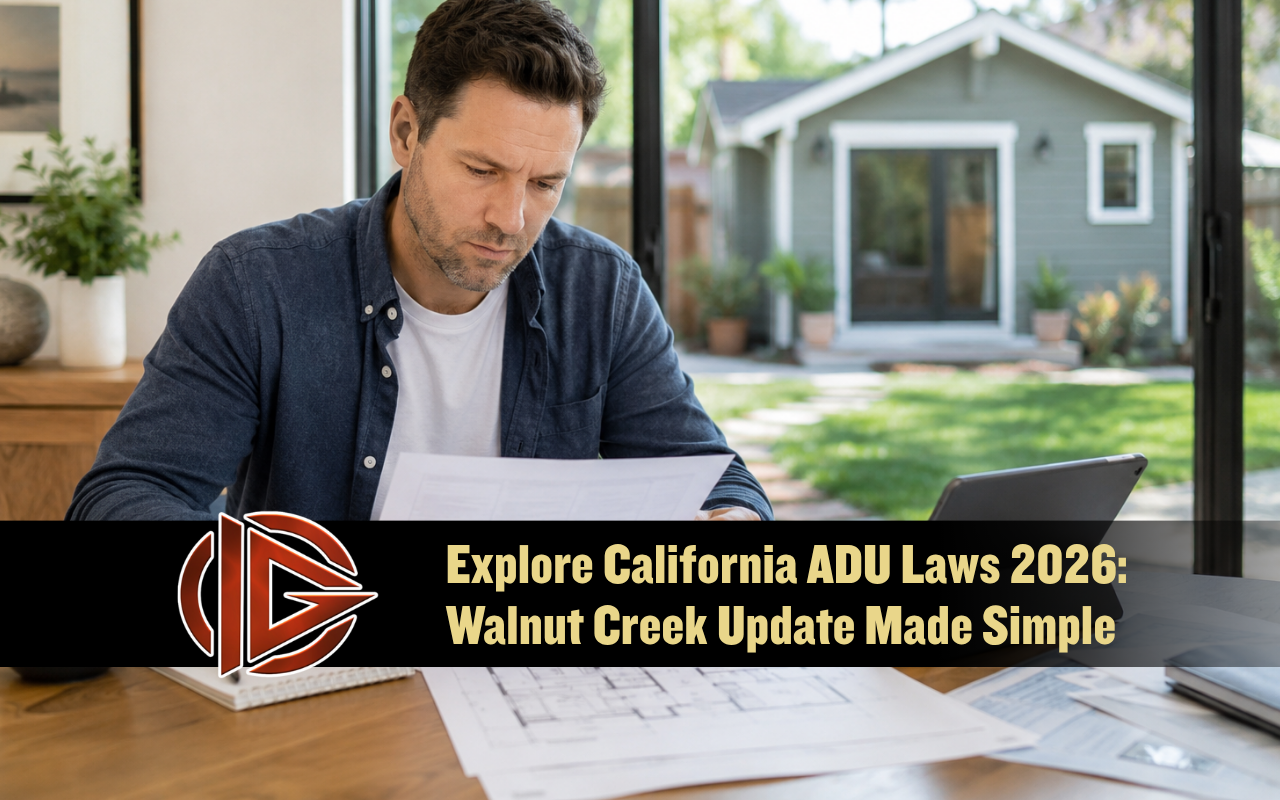
The California ADU laws 2026 Walnut Creek update affects how homeowners plan, submit, and review accessory dwelling unit projects. State changes now address application completeness, some fees, junior ADU rules, and local compliance. Understanding these points early can help you avoid preventable permit problems.
At Ingenious General Construction, we guide property owners through practical planning and construction decisions. Our overview of California ADU construction services explains how design, site conditions, permits, and building work fit together.
State and Local Rules Work Together
California law sets basic standards that cities must follow when reviewing ADUs. Walnut Creek may also apply objective zoning, building, fire, utility, and site standards when those requirements comply with state law. This balance means that state eligibility does not remove every local review step.
The California ADU laws 2026 Walnut Creek update should therefore be considered alongside current city forms, checklists, and municipal rules. Homeowners should confirm requirements with Walnut Creek before completing a design because local procedures and property conditions can affect the documents needed for approval.
State law generally calls for ministerial review when an application meets clear standards. It also limits subjective decisions that could block an otherwise compliant ADU. California’s housing department may review local ordinances and address rules that conflict with state requirements. :contentReference[oaicite:0]{index=0}
What Changed in ADU Laws This Year?
The new ADU regulations 2026 focus mainly on clearer applications, junior ADU requirements, selected fee rules, and stronger oversight of local ordinances. They do not create one universal design that works on every Walnut Creek property.
- Permitting agencies must review application completeness and send written notice within 15 business days.
- An incomplete notice must identify missing items and explain how the applicant can complete the submission.
- Applicants must have access to a process for challenging certain incomplete or denied applications.
- Junior ADUs remain limited to no more than 500 square feet of interior livable space.
- A junior ADU cannot be used as a short-term rental and must be rented for more than 30 days.
- Impact fees cannot be charged for an ADU with 750 square feet or less of interior livable space.
Owner-occupancy rules for a junior ADU now depend partly on whether it shares sanitation facilities with the main home. These updates took effect through legislation adopted in 2025, with important provisions becoming effective on January 1, 2026. :contentReference[oaicite:1]{index=1}
Permit Planning Before Design Work Begins
A strong application begins with accurate property information. Confirm the lot boundaries, zoning district, easements, utility locations, existing structures, and any recorded restrictions. These details can influence whether an attached, detached, converted, or junior ADU is the practical choice.
With Ingenious General Construction, you can review the project goal before moving too far into drawings. We consider access, privacy, available yard space, utility paths, and the relationship between the proposed unit and the main residence.
The California ADU laws 2026 Walnut Creek update also makes application preparation more important. Although the city must identify incomplete items, a missing survey, unclear floor plan, or inconsistent measurement can still interrupt the review. A complete package gives the reviewer a clearer basis for making a decision.
Homeowners researching nearby projects can also review our ADU planning information for Fremont. Local requirements differ, but the page shows how early design and construction planning can support an organized project.
ADU Setbacks and Site Limits to Review
The ADU setback rules update did not replace every existing placement standard. State law generally prevents a city from requiring more than four feet for side and rear setbacks on many newly built ADUs. Different rules may apply to conversions, front setbacks, fire access, easements, or unusual site conditions.
- Locate the legal front, side, and rear property lines.
- Check recorded utility, drainage, access, and private easements.
- Measure the distance from existing buildings and outdoor features.
- Review fire access and emergency response needs.
- Confirm whether the property is affected by slope or hillside conditions.
- Identify trees, retaining walls, pools, and utility equipment near the building area.
A setback that works on a basic drawing may still conflict with an easement or required access path. A professional survey can reduce this risk. It can also help the design team place the ADU without relying on fences or landscaping as assumed property boundaries.
Design Choices That Support Permit Review
ADU design should respond to the property rather than copy a plan that was made for another lot. Size, height, windows, roof form, entrances, parking, and utility connections can all affect the final layout. Objective local standards may also guide some exterior details.
Our team at Ingenious General Construction can connect practical construction needs with the proposed design. This includes reviewing how workers and materials may reach the building area, where utility trenches may run, and how the new unit may affect the existing home.
An ADU builder following 2026 regulations should also distinguish state rules from local building requirements. State planning law may support the unit, while structural, energy, electrical, plumbing, and safety codes still shape how it must be built.
Preapproved plans may shorten part of the design review, but they are not automatically suitable for every site. The foundation, utility plan, grading, fire conditions, and property layout may still require separate work or adjustments.
Homeowner Checklist for a Stronger Application
Good preparation can make discussions with designers, builders, and city staff more useful. Before selecting a final layout, collect the information that may affect the project’s size, position, access, and intended use.
- Define whether the unit will support family, guests, long-term housing, or another permitted use.
- Obtain reliable measurements and confirm the property boundaries.
- Choose between a detached, attached, conversion, or junior ADU concept.
- Review the proposed size against state and local standards.
- Identify possible utility routes before fixing the floor plan.
- Prepare the drawings and documents required by the current city checklist.
- Confirm permit comments before ordering materials or starting construction.
When you need project-specific guidance, use our ADU project consultation page to share your property details and construction goals.
Frequently Asked Questions
Does the 2026 update allow an ADU on every property?
No. The California ADU laws 2026 Walnut Creek update supports ADUs on many residential and mixed-use properties, but eligibility still depends on the site, existing development, safety conditions, and applicable standards. Our California ADU project guide can help you understand the main options before confirming local requirements.
How quickly must Walnut Creek review an ADU application?
State law generally requires a permitting agency to approve or deny a completed application within 60 days when an existing dwelling is already on the property. The agency must now determine completeness within 15 business days. The timeline may vary when applications are combined, delayed by the applicant, or affected by specific circumstances. :contentReference[oaicite:2]{index=2}
Are side and rear setbacks now three feet?
No general 2026 state change reduced the standard limit to three feet. State law commonly limits required side and rear setbacks to four feet for qualifying new ADUs. Conversions and replacement structures may follow different standards. Property owners should confirm the rule that applies to their design and lot.
Can a junior ADU be used as a short-term rental?
No. A junior ADU must now be rented for longer than 30 days when it is offered for rent. Other occupancy and rental rules may also apply. Property owners planning a smaller unit can discuss junior ADU planning with our team. :contentReference[oaicite:3]{index=3}
When should I involve an ADU builder?
Builder input is useful before the design becomes difficult to change. Early review can identify access limits, utility challenges, construction space, and layout concerns. When you choose Ingenious General Construction, we can review these practical factors before construction begins. You can also explore our local ADU construction approach.
Plan Your Walnut Creek ADU With Clarity
The California ADU laws 2026 Walnut Creek update gives homeowners clearer protections during application review, but successful projects still depend on accurate site information and coordinated planning. Confirm current city requirements before relying on a standard plan or beginning construction work.
At Ingenious General Construction, we focus on turning the approved design into a practical building plan for your property. Share your goals through our Walnut Creek ADU project contact page so we can discuss the site, intended use, and next construction steps.


